Sega Consoles: Complete History, Timeline & Legacy (Ultimate 2026 Guide)
Quick Answer: What This Sega Consoles Guide Covers
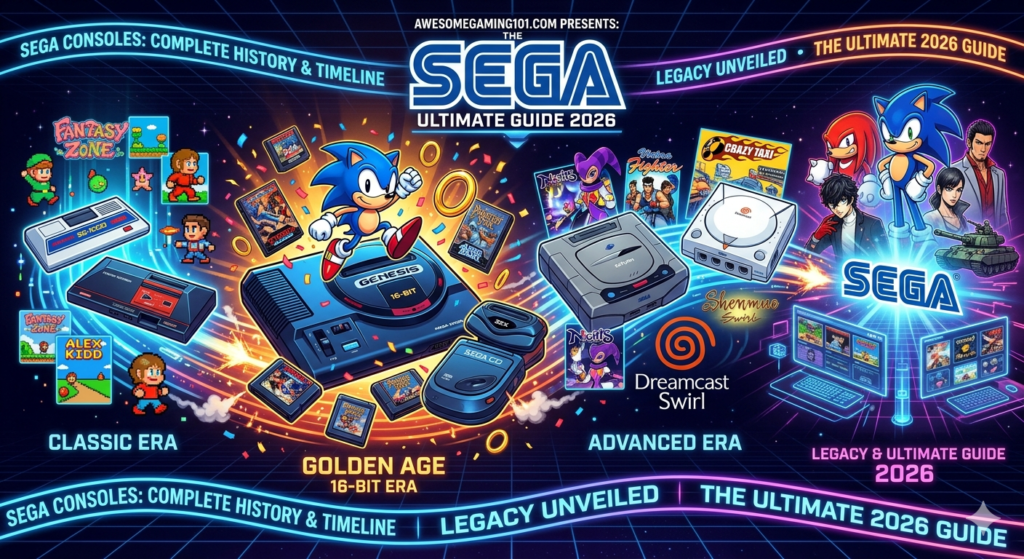
This guide is a complete, research-backed overview of every major Sega console: home systems, handhelds, add-ons, and the final transition from hardware maker to third-party publisher. If you want a single page that explains what Sega consoles exist, when they released, how they fit into gaming history, and which ones still matter today, this is it.
We’ll walk through a chronological Sega console timeline, highlight key specs and innovations, compare regional differences, and give practical advice for collectors and retro gamers who want to experience Sega hardware in 2026 and beyond.
By the end, you’ll understand not just the list of Sega consoles, but why Sega’s hardware era still shapes modern gaming.
Full Sega Console Timeline (1983–2001)
Sega’s console history spans from the early 1980s to the early 2000s, covering the 3rd through 6th console generations. Below is a concise Sega console list in chronological order, focusing on major home systems, handhelds, and add-ons.
- 1983: SG-1000
- 1984: SG-1000 II / SC-3000 (variants)
- 1985 (JP) / 1986–87 (WW): Sega Mark III / Sega Master System
- 1988 (JP) / 1989 (NA): Sega Mega Drive / Genesis
- 1990: Sega Game Gear
- 1991: Mega-CD / Sega CD (Genesis add-on)
- 1994: Sega 32X (Genesis add-on)
- 1994 (JP) / 1995 (NA/EU): Sega Saturn
- 1998 (JP) / 1999 (NA/EU): Sega Dreamcast
Depending on how you count variants and regional rebrands, there are over a dozen distinct Sega consoles and add-ons. For clarity, we’ll focus on the systems that had meaningful commercial or historical impact.
SG-1000: Sega’s First Console (1983)
The SG-1000 was Sega’s first home console, released in Japan on July 15, 1983—the same day Nintendo launched the Famicom. It used 8-bit hardware with ROM cartridges and later supported Sega Card games via an adapter.
While the SG-1000 never reached the global popularity of the NES, it laid the foundation for Sega’s hardware business and introduced early versions of franchises and design ideas that would evolve on later systems.

Sega Master System: 8-Bit Challenger to the NES
The Sega Master System began as the Sega Mark III in Japan and was rebranded for international markets. It competed directly with the Nintendo Entertainment System in the 8-bit era.
In North America and Japan, the Master System lagged behind Nintendo due to licensing and market dominance. However, it became a major success in Europe and Brazil, where it outlived the NES and continued to receive new games for years.
For collectors, the Master System is a fascinating console because its library and box art differ significantly by region. Brazilian releases and late European titles are especially interesting for completionists.
Sega Genesis / Mega Drive: 16-Bit Icon
When people talk about “Sega consoles,” they usually mean the Sega Genesis (known as the Mega Drive outside North America). Released in 1988 in Japan and 1989 in North America, it was Sega’s most successful home console.
The Genesis delivered fast 16-bit arcade-style action, aggressive marketing, and iconic franchises like Sonic the Hedgehog, Streets of Rage, and Phantasy Star. It positioned Sega as the “cool” alternative to Nintendo in the early 1990s.
Genesis Add-Ons: Sega CD and 32X
Sega experimented heavily with hardware expansions for the Genesis:
- Sega CD (Mega-CD): A CD-ROM add-on that enabled full-motion video games, Red Book audio, and larger storage.
- 32X: A mushroom-shaped add-on that plugged into the Genesis cartridge slot to provide 32-bit graphics.
While technically interesting, these add-ons fragmented the user base and confused consumers. They are now cult collector items, especially complete-in-box units and working Sega CD hardware.
Sega Game Gear: Color Handheld Rival
The Game Gear was Sega’s color handheld console, launched in 1990. It shared much of its architecture with the Master System, which allowed for ports and conversions of 8-bit Sega games.
Compared to the Game Boy, the Game Gear offered a backlit color screen and more advanced visuals, but at the cost of heavy battery usage. For modern collectors, capacitor issues and screen problems are common, so refurbished or recapped units are highly recommended.
Sega Saturn: 32-Bit Powerhouse with a Complex Legacy
The Sega Saturn launched in Japan in 1994 and in North America and Europe in 1995. It was a 32-bit console designed with 2D arcade ports in mind, featuring multiple processors and a complex architecture.
The Saturn struggled in North America due to a surprise early launch, high price, and limited third-party support. However, in Japan it developed a strong library of 2D fighters, RPGs, and niche titles that are now highly sought after.
For Sega console collectors, the Saturn is a deep rabbit hole: Japanese exclusives, limited print runs, and expensive late releases make it one of the most challenging Sega systems to collect for.
Sega Dreamcast: The Final Sega Console
The Dreamcast was Sega’s last home console, released in 1998 in Japan and 1999 in North America and Europe. It is often remembered as being “ahead of its time,” with built-in modem support, online play, and arcade-perfect ports.
Despite a strong launch and beloved games like Shenmue, Jet Set Radio, Phantasy Star Online, and Soulcalibur, the Dreamcast was discontinued in 2001 as Sega exited the hardware business and became a third-party publisher.
Today, the Dreamcast has a vibrant fanbase, an active homebrew scene, and ongoing indie releases. It’s one of the most rewarding Sega consoles to own if you enjoy experimenting with mods, optical drive emulators, and fan translations.
From Sega Consoles to Sega as a Publisher
After discontinuing the Dreamcast, Sega shifted fully into third-party publishing. Instead of releasing new Sega consoles, the company began putting its games on rival platforms like PlayStation, Xbox, and PC.
This transition means that in 2026, the best way to experience Sega’s legacy is a mix of:
- Original Sega consoles (for authentic hardware and CRT setups).
- Official collections and mini consoles (for convenience and HDMI output).
- Modern Sega releases on current platforms that revive classic IPs.
Sega consoles may be discontinued, but Sega’s influence is still visible in modern game design, arcade-style gameplay, and the ongoing popularity of its franchises.
Collecting Sega Consoles in 2026
If you’re planning to collect Sega consoles today, it helps to prioritize based on availability, reliability, and game library. Here’s a practical way to approach it:
Best Starting Point: Genesis / Mega Drive
The Genesis is usually the best first Sega console to buy:
- Large, iconic library (Sonic, Streets of Rage, Golden Axe, Phantasy Star).
- Multiple hardware revisions and clone systems.
- Strong support from flash carts and FPGA systems.
Most Underrated: Master System and Game Gear
The Master System and Game Gear are underrated outside Europe and Brazil. They offer a different flavor of Sega’s 8-bit era, with unique ports and regional exclusives.
Most Advanced & Niche: Saturn and Dreamcast
The Saturn and Dreamcast are where Sega’s creativity peaked. They’re more expensive to collect for, but they reward you with deep libraries, imports, and a strong modding scene.
Related Guides on AwesomeGaming101
Want to go deeper on specific Sega consoles and retro hardware? Check out these related guides:
Authoritative Resources on Sega Consoles
For deeper technical specs, release dates, and historical context, these external resources are worth bookmarking:
FAQ: Sega Consoles
How many Sega consoles were released?
If you include major home consoles, handhelds, and add-ons, Sega released over a dozen distinct systems. The core list includes SG-1000, Master System, Genesis/Mega Drive, Game Gear, Saturn, and Dreamcast, plus add-ons like Sega CD and 32X.
What was Sega’s last console?
Sega’s last home console was the Dreamcast. It launched in 1998 in Japan and 1999 in North America and Europe. Sega discontinued the Dreamcast in 2001 and transitioned fully into third-party publishing.
Which Sega console should I buy first?
For most players, the best starting point is the Sega Genesis/Mega Drive library, either on original hardware, FPGA systems, or official collections. It has a huge library, strong emulation support, and relatively affordable entry costs.
Are Sega consoles still being made?
Sega no longer manufactures traditional home consoles like the Genesis or Dreamcast. However, Sega has licensed its IP for mini consoles and collections, and its classic games continue to appear on modern platforms.
Ready to Dive Deeper into Sega Consoles?
If this Sega consoles guide helped you map out the hardware timeline and decide where to start, your next step is simple: pick one system and build a focused setup.
Head over to our in-depth guides on the Genesis, Saturn, and Dreamcast, compare hardware options, and start building the Sega collection you always wanted.