
PlayStation 1 Specs: Complete PS1 Hardware Guide, Technical Breakdown & History
Overview of PlayStation 1 Specs
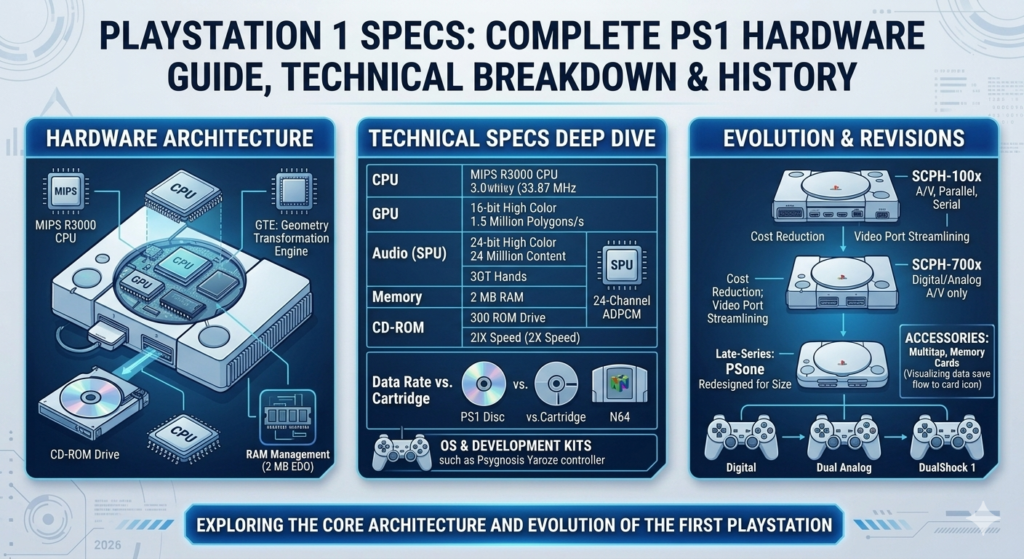
The original PlayStation 1 introduced a hardware architecture that defined 3D gaming for an entire generation. Its combination of a 32‑bit RISC CPU, dedicated geometry hardware, CD‑ROM storage, and flexible audio system made it one of the most influential consoles ever released. This guide provides a complete breakdown of PS1 specs, including CPU, GPU, RAM, audio, video output, storage, and hardware revisions.
PlayStation 1 CPU Specifications
At the core of the PS1 is a MIPS R3000A processor, a 32‑bit RISC CPU known for its efficiency and reliability.
- CPU: MIPS R3000A-compatible 32‑bit RISC
- Clock Speed: 33.8688 MHz
- Instruction Cache: 4 KB
- Co‑processor: Geometry Transformation Engine (GTE)
The GTE handled matrix math, lighting, and polygon transformations, enabling the PS1 to deliver fast 3D performance despite modest clock speeds.
PlayStation 1 GPU Specifications
The PS1’s GPU was designed for real‑time 3D rendering with a focus on speed over precision.
- Rendering: Flat and Gouraud shading
- Polygons: Textured and untextured triangles/quads
- Fill Rate: ~360,000 polygons per second (real‑world)
- VRAM: 1 MB
- Framebuffer: 512 KB
The PS1 lacked hardware perspective correction, which contributed to the characteristic “warping textures” seen in many games.
PlayStation 1 RAM & Memory Architecture
- System RAM: 2 MB
- Video RAM: 1 MB
- Sound RAM: 512 KB
- CD Buffer: 32 KB
Developers relied heavily on streaming data from the CD‑ROM to compensate for limited RAM, influencing game design and loading sequences.
PlayStation 1 Audio Specifications
The PS1’s audio system was one of its strongest features, enabling high‑quality music and sound effects.
- Sound Channels: 24‑channel ADPCM
- Sampling Rate: Up to 44.1 kHz
- Effects: Reverb, pitch modulation, looping
- CD Audio: Red Book audio support
PlayStation 1 Video Output Specifications
- Resolutions: 256×224 to 640×480
- Color Depth: 16‑bit (65,536 colors)
- Output Formats: Composite, S‑Video, RGB (region‑dependent)
Many PS1 games ran at 240p or 288p, which paired well with CRT displays and contributed to the console’s distinct visual style.
PlayStation 1 Storage & Media
- Media Format: CD‑ROM
- Capacity: Up to 700 MB per disc
- Save System: Memory cards (128 KB)
The move to CD‑ROM allowed for full‑motion video, CD‑quality audio, and larger game worlds compared to cartridge‑based competitors.
PlayStation 1 Hardware Revisions
Sony released multiple PS1 hardware revisions, each with small internal changes affecting performance, audio quality, and modding compatibility.
SCPH‑100x Series
Early models known for high‑quality RCA audio output and unique internal layouts.
SCPH‑500x to SCPH‑900x
Later revisions with simplified internals, improved reliability, and reduced manufacturing costs.
PSone (2000)
A compact redesign with identical performance but a smaller footprint and optional LCD screen.
PlayStation 1 Performance Characteristics
Real‑world PS1 performance depended heavily on developer optimization. Games like Gran Turismo, Metal Gear Solid, and Final Fantasy VIII demonstrated how far the hardware could be pushed.
FAQ: PlayStation 1 Specs
What CPU does the PS1 use?
A 32‑bit MIPS R3000A RISC processor at 33.8688 MHz.
How much RAM does the PS1 have?
2 MB of system RAM and 1 MB of VRAM.
What resolution does the PS1 output?
Between 256×224 and 640×480 depending on the game.
Does the PS1 support 3D graphics?
Yes — it includes hardware for polygon rendering and 3D transformations.
Conclusion
The PlayStation 1’s hardware defined an era of 3D gaming and set the foundation for modern console design. Its balanced architecture, CD‑ROM storage, and flexible audio system allowed developers to create some of the most iconic games ever released. Even decades later, the PS1 remains a landmark in gaming history and a system whose technical design continues to be studied and appreciated.