Enter the puzzle’s finished width and height, then the clear usable area of your board or table. The calculator checks both orientations and adds the working margin you choose around every side.
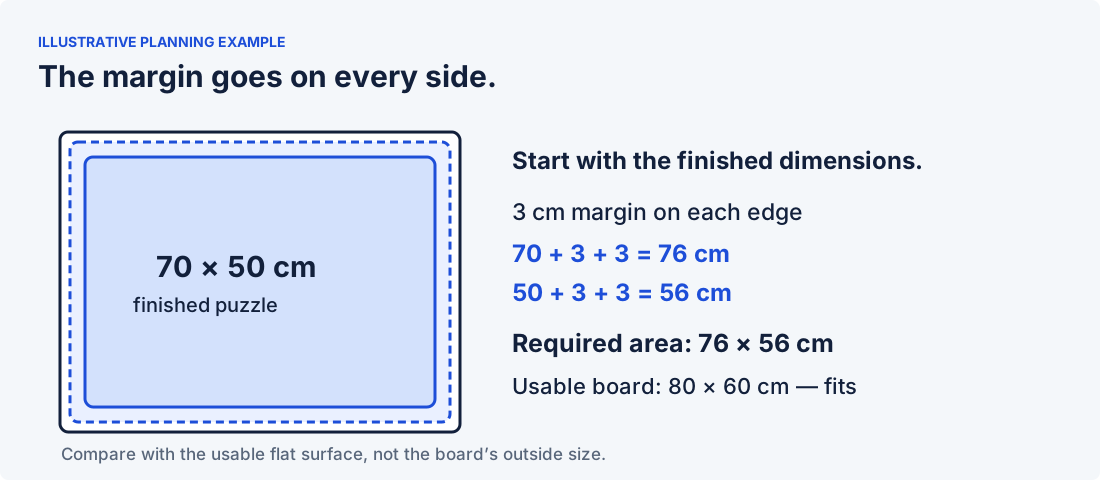
Enter the finished puzzle dimensions and the usable board surface. The sorting margin is reserved on every side; box size and piece count are not substitutes for finished dimensions.
Loading the interactive controls…
Use finished dimensions
A piece count or storage-box size does not establish a puzzle’s assembled footprint. Find the dimensions for the exact title and product number, especially for panoramic, shaped, wooden, or unusually large puzzles.
The usable surface excludes raised borders, handles, hinges, and areas you cannot work on. A fit with zero spare room means the rectangle fits mathematically; it does not leave sorting space or prove that the board’s storage cover will close over the puzzle.
Choose a practical margin and account separately for trays and loose pieces. Rotation is useful only when you can also reach and work comfortably in that orientation. Recheck measurements after changing units or selecting another puzzle.