Choose games for the group and make room for the parts of the evening that a box’s play-time estimate may omit. Include setup, a first explanation, actual play, and the transition to the next game.
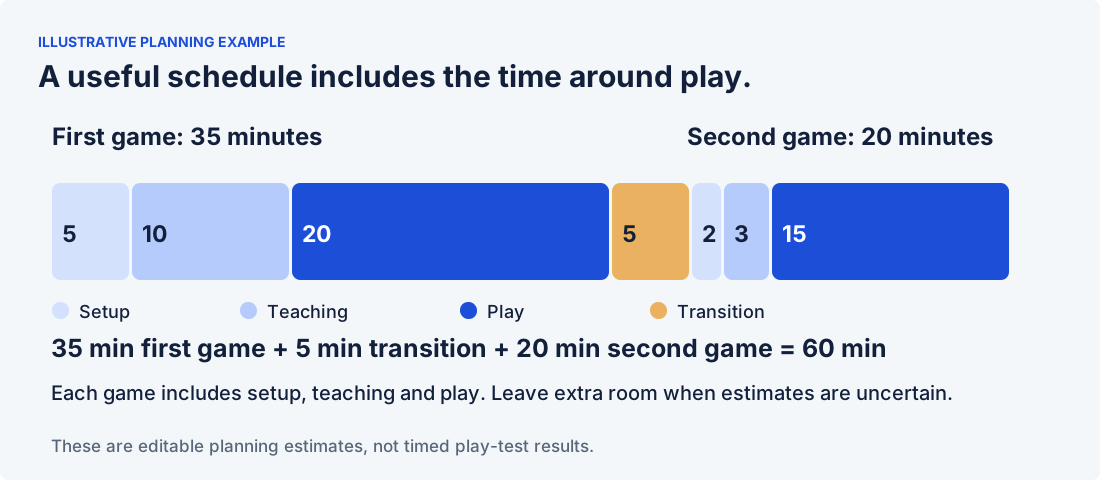
Build a schedule from selected games, your group and explicit time estimates. Setup, teaching, play and transitions are included; estimates are editable and not measured play-test claims.
Loading the interactive controls…
Use estimates deliberately
Adjust the timing for your group and label your assumptions. New players, discussion, breaks, accessibility needs, and unfamiliar equipment can change the schedule. The planner’s arithmetic is exact for the numbers entered; the evening itself is not guaranteed to follow those estimates.
Review player counts, required extras, and the table footprint for each selection. Packaging dimensions do not establish playing space. An unchecked equipment requirement or missing footprint should remain visible instead of turning into a confident fit.
Keep a shorter alternative available if the first game runs long. A useful plan makes the tradeoff visible: fewer games with an unhurried explanation may suit the group better than a schedule that leaves no room to learn.