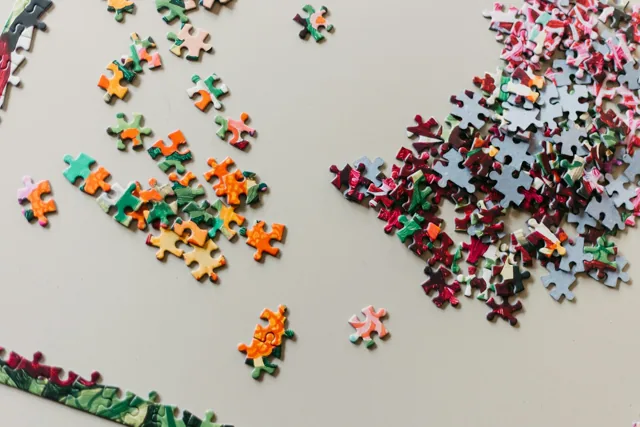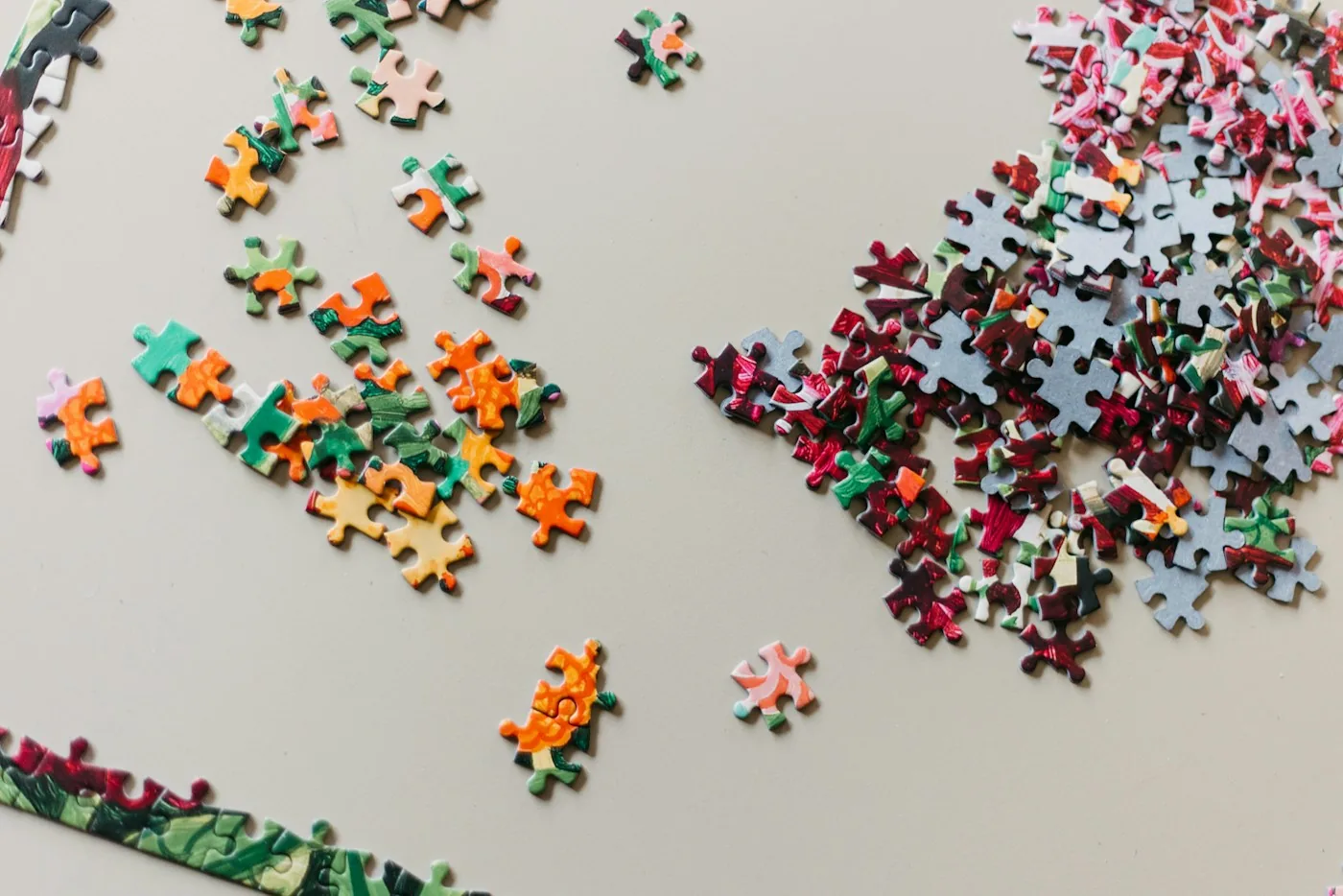
Choose a jigsaw challenge by looking at the picture, the cut and the physical workspace together. Piece count tells you how many placements are involved; it does not tell you how distinctive those placements will be or whether the sorting process will suit you.
Assess the image in sections
Before buying, divide the cover image mentally into areas you could recognize while sorting. Distinct objects, changes in color and clear boundaries can give you several starting points. Repeated textures or broad areas with little variation may give fewer immediately identifiable clues. These are selection judgments, not a measured difficulty score.
A busy picture is not automatically harder. A scene with many separate, recognizable objects can provide useful landmarks, while a quieter scene may contain large regions of similar tones. Decide whether you enjoy searching for picture details or concentrating on subtle shape differences.
| Factor | Question to ask |
|---|---|
| Image repetition | Will many loose pieces appear interchangeable at first glance? |
| Cut style | Are shapes regular, irregular, repetitive or deliberately unusual? |
| Outer shape | Is there a conventional straight border, a circle or a shaped outline? |
| Piece handling | Do you want fewer larger objects or more smaller pieces? |
| Workspace | Can you spread the pieces enough to use your preferred sorting method? |
Read the cut description carefully
Ravensburger’s difficulty guide treats piece count, cut style and image complexity as separate factors. Wentworth’s Whimsical Nature Free Form page illustrates how a named wooden product can introduce a nonstandard shape and themed cut. Do not assign a numerical difficulty merely from the material or brand.
A lower piece count with unusual boundaries can provide a different challenge from a larger regular rectangular puzzle. Conversely, a familiar style at a larger count may feel approachable if you enjoy that kind of image. Compare exact products rather than declaring every wooden, panoramic or mystery puzzle harder.
Set a practical challenge target
Choose one dimension to change at a time when possible. If your last puzzle was satisfying, you could try a less varied image at a similar count, or a higher count with a similarly recognizable image. That makes your own experience more informative than jumping simultaneously to a new material, shape and count.
Avoid promises such as a 500-piece puzzle takes a certain number of hours. People differ, interruptions vary, and remembering a picture changes a repeat solve. If you want a short session, choose a puzzle you can comfortably pause and store rather than relying on a made-up completion estimate.
Make sure difficulty does not come from a poor fit
Check finished dimensions against your board and reserve room for loose pieces. A storage system that compresses all sorting into one pile can make the experience different from the same puzzle on a larger table. Lighting, reach and how often you must clear the surface also affect your practical choice.
For a gift, ask whether the recipient likes detailed scenes, gradients, unusual cuts or hidden solutions. Use the manufacturer’s age and component guidance for the exact item. Describe your reason for choosing it without promising that everyone at a particular age or experience level will find it easy.
Sources and method
This researched guide uses the publisher or manufacturer sources below, checked November 2, 2026. Comparisons, buying criteria and worked examples are editorial reasoning. This guide does not include hands-on testing or measured solving times.