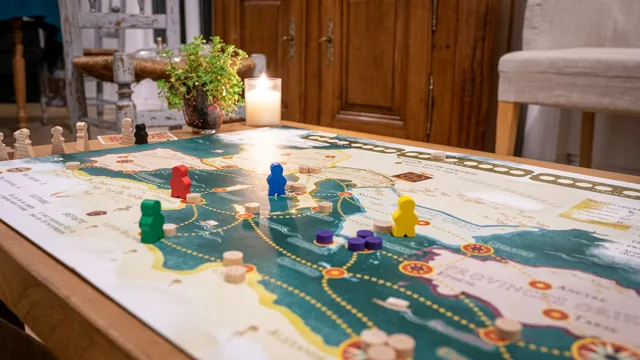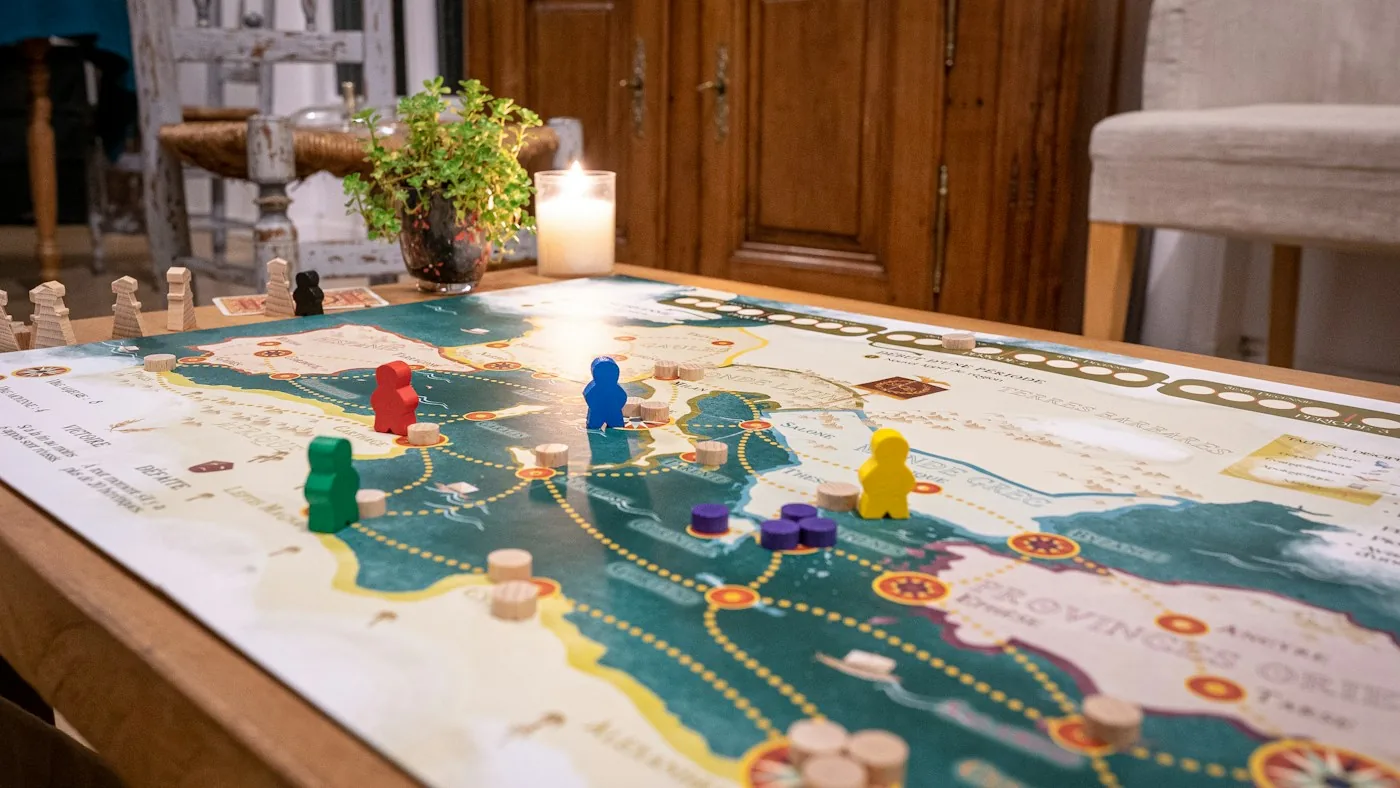
A game designed for two gives you a complete two-person structure. A game whose range begins at two may scale its ordinary rules, use special procedures or offer a separate mode. Neither category guarantees a better experience; the useful question is what the two-player rules actually ask you to do.
| Product or situation | What the count establishes | What to inspect next |
|---|---|---|
| Hive Pocket | The publisher specifies two players. | The movement rules and style of direct competition. |
| 7 Wonders Duel | A separate game built around two opponents. | Its own components and rules, rather than those of 7 Wonders. |
| Ticket to Ride base game | The published range includes two. | Count-specific route restrictions and the exact map. |
| An optional two-player variant | A rule set may allow two people. | Whether it adds neutral pieces, shared control or different scoring. |
A dedicated duel is its own product
7 Wonders Duel is described by its publisher as a two-player adaptation with its own card-display system. It is not a pair of extra seats for the larger game or an expansion required to make that box playable. Match the full title when buying.
A dedicated format can make the relationship between players easy to identify: every competitive choice concerns the same opponent. That does not prove it is simpler, kinder or faster. It may concentrate direct competition more strongly than the pair wants.
Scaling can be a deliberate design choice
Ticket to Ride’s base game officially supports two to five players. Its two-player rules close the second half of a double route after the first is claimed. This is a specific adjustment to shared space, not evidence that the smaller game is unfinished.
Look for changes in board area, market size, available actions, scoring or starting resources. A scaled game may preserve its central mechanism while changing how frequently players interfere with each other. Describe that rules difference before making a preference judgment.
Inspect neutral players and extra administration
If the rules require a dummy hand, automated opponent or neutral pieces, determine who manages them and when. Are you making meaningful decisions for the extra position, drawing a card for it, or merely removing options? Those are different amounts of handling.
A neutral system can be enjoyable when it creates useful tension. It can also be unsuitable when you want a minimal setup or dislike operating a third position. Do not call it bad by definition; compare the actual steps with your reason for choosing a two-person game.
Choose your preferred relationship
Decide whether you want a competitive duel, a cooperative puzzle, parallel personal construction or a shared discussion. Player count alone does not answer that. Also consider hidden information, reading, direct attacks and whether either person can be eliminated before the end.
For unequal experience, ask how much a first-time player can understand from the visible position. We have not measured win rates or tested a teaching handicap. Use official variants where available and identify any house rule as your own adaptation.
Check the edition and future group size
If you expect to play with three or four later, a scalable game may serve several occasions. If the game will almost always be used by the same pair, a dedicated design may be a more focused choice. Buying for a hypothetical larger group should not override the experience you actually want now.
Keep the evidence clear: supported count, exact two-player procedure, and your preference about that procedure. That is a better basis for a purchase than treating the smallest number on every box as a quality score.
Sources and method
This guide uses the primary publisher or manufacturer sources below, checked November 2, 2026. The selection criteria and examples are editorial analysis. This guide does not include hands-on tests, measured play or setup times, or universal rankings.
- Gen42 Hive Pocket: two players, 26 pieces, no fixed board and publisher luck rating
- Asmodee/Repos 7 Wonders Duel: a separate two-player game
- Days of Wonder Ticket to Ride: base game player range and route-building premise
- Ticket to Ride 2025 English rulebook: route actions and two/three-player double-route limit
We may earn a commission when you purchase through links on this page. As an Amazon Associate I earn from qualifying purchases.